
[Agriculture is IT] GAYABIO “Functional Compound Feed”
[KOAT x ITDongA] Korea Agriculture Technology Promotion Agency and ITDongA introduce promising startups that will lead the development and digital transformation of Korean agriculture.
Meet the agriculture startups from around the country that are enriching our lives with their quirky ideas, products, and ingenious technology.
Tighter global carbon emissions regulations have made going green a necessity for many industries. The livestock industry, which emits large amounts of methane and nitrous oxide, is no exception.
Gaya Bio, a functional feed manufacturer, helps eco-friendly management of the livestock industry by understanding how ruminants such as dairy cows and Korean beef cattle produce methane.
It involves mixing natural ingredients in the feed that inhibit methane-producing microbes, leading the animal to emit less methane gas.
We met with Kim Hee-gyeom, CEO of GayaBio, who plans to improve the local environment by making feed that reduces odor for livestock.

Gaya Bio, a functional feed manufacturer, was founded in 2018 as a one-person company. “My father owns a compound feed company for livestock in China,” says CEO Kim Hee-gyeom. “When I visited the factory, I realized that I needed to introduce various technologies to the food and feed of livestock.
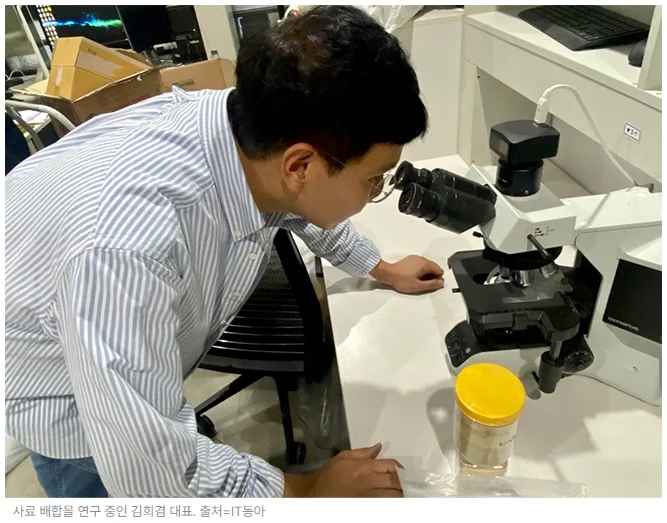
The ingredients in the feed that animals eat ultimately affect the people who eat the meat. I decided to create a feed that is healthier and more environmentally friendly,” said Kim. After leaving his job at a financial company, Kim enrolled in the Graduate School of Agriculture and Life Sciences at Seoul National University to begin his research.
Trial and error in feed manufacturing
Although he comes from a family business, he had no experience making compound feed for livestock. After a lot of trial and error, he was able to apply the technology.
“After completing graduate school, I produced feed in the OEM method with the results of my own research,” he says. “There were many trials and errors because I had no experience. When I said that I had developed a good functional feed, there was a demand to bring it somewhere,” he explains, “so it was essential to cooperate with an outsourcing company to produce the feed.”.
“Once, we were making amino acid fortified feed for a vendor and transporting it in a truck, but when we ripped open the foam bag it was wrapped in, the product wouldn't come out.
”You have to mix the excipients to prevent it from solidifying, but you don't have the right proportions,“ he says.
I ended up punching and smashing the foam bags myself and working up a sweat,” he laughs.
The process of building trust with farmers was not easy. “We needed to secure data to gain the trust of farmers and related companies, and we needed samples that maintained quality no matter where they were taken,” says Kim. “We spent countless nights searching for papers and honing our skills to get grades that would be trusted by farmers from recognized organizations.”.
Man Hours Pay Off...Developing Solutions for Methane, Nitrous Oxide Reduction
After years of hard work, CEO Kim Hee-gyeom is finally starting to see results. He focused on how ruminants such as dairy cows, beef cattle, and Korean beef produce methane.
“Ruminants ferment their ingested feed and forage (grass) in their massive rumens and derive the nutrients they need for maintenance and growth from these fermentation products. The problem is that during this fermentation process, methanogenic microorganisms (methanogens) living in the rumen combine carbon sources (C) with hydrogen ions (H+) to produce large amounts of methane (CH4),” he explains.
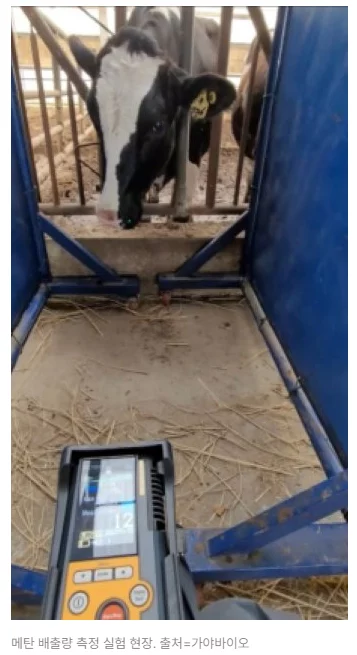
“By focusing on the principle of methane production, we developed a methane-reducing feed that reduces the amount of methane from the ground up by using natural ingredients (algae, garlic by-products, green tea, persimmon) that contain a large amount of substances that inhibit methane-producing microorganisms and natural ingredients (unsaturated fatty acids) that reduce hydrogen ions.” “As a result of industry-academia collaboration, we have achieved a reduction of about 301 TP3T of methane, and we are working to commercialize the product as soon as possible,” said Dr. Lee.
Gayabio is also developing a solution to reduce nitrous oxide. CEO Kim Hee-gyeom said, “Nitrous oxide is mainly produced in the feces of unit animals with one stomach, such as pigs and chickens. When the proteins in the feed fed to pigs and chickens are discharged into the feces in a less decomposed state, the nitrogen source from these undecomposed proteins is converted into nitrous oxide.”.
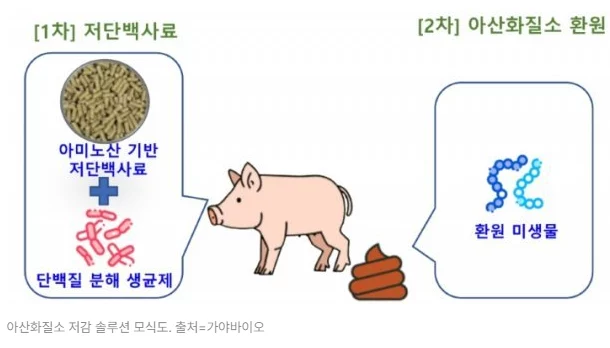
“GayaBio reduces excess protein in feed while utilizing the complex amino acids needed for animal growth. We feed animals with special probiotics that promote protein breakdown, and we are developing nitrous oxide reduction technology by collecting and culturing microorganisms that reduce nitrous oxide to nitrogen in various environments and applying them to feces.”.
‘Odor' is a problem in livestock farming, but functional feeds can help
Along with greenhouse gases, odor is one of the things the livestock industry needs to improve. In 2019 alone, there were 12,631 livestock-related complaints, most of which were reportedly due to odors. That's up from 2,838 in 2014.
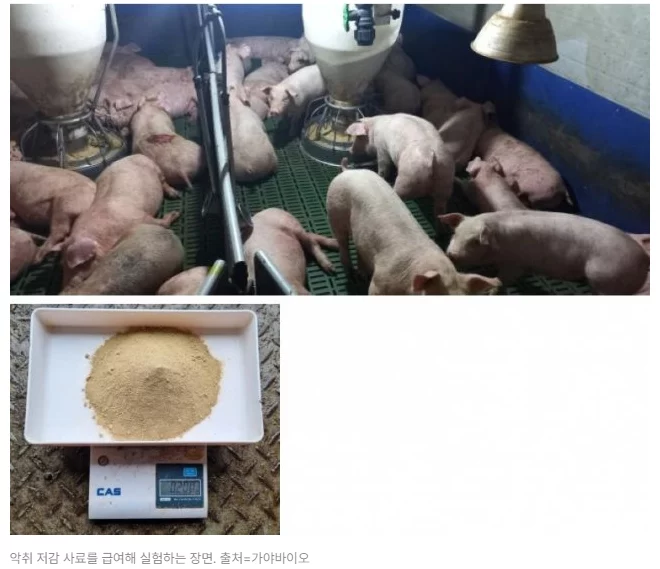
“We achieved an odor reduction effect of 15 to 401 TP3T by administering a combination of beneficial microorganisms developed to inhibit microorganisms that cause odors in animals, such as ammonia and hydrogen sulfide, to livestock,” said Kim Hee-gyeom.
Government support for good tech continues
The company's success in developing functional food with environmental and healthy food considerations has led to government support.
Starting with the Agricultural Technology Commercialization Foundation's ‘Agri-Food Venture Development Support Project‘ in 2020, Gayabio was selected for the Ministry of SMEs and Startups’ ‘Startup Growth Technology Development Project’ in 2020, ‘SME Network Project’ in 2020, ‘Technology Innovation Development Project’ in 2022, ‘IP Narae Project' of the Korea Intellectual Property Office, and 'Agri-Food Venture Development (High-Tech) Project' of the Korea Agricultural Technology Promotion Agency.
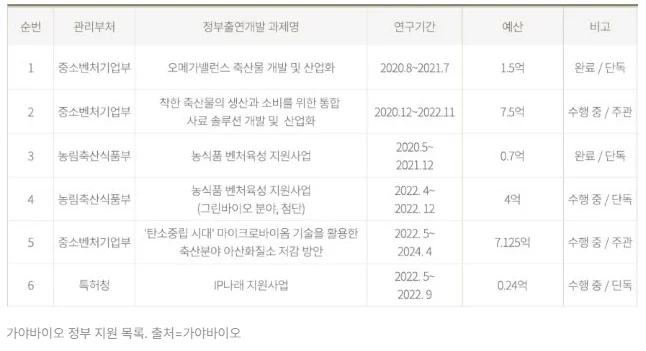
“I think that being selected for various government support projects is a recognition of GayaBio's technology and future growth potential,” said Kim Hee-gyeom, CEO of GayaBio.
We will use the taxpayers” money carefully to contribute not only to the growth of the company but also to the country and society.".
Moving away from OEMs and into direct production.
“The outsourced production method is vulnerable to external uncertainties such as the blockade of Shanghai, China. If logistics costs skyrocket, it is difficult to maintain profitability.” “Therefore, we will finalize the construction of our own factory near Gwangyang Port in Jeonnam by this year and start producing products directly from next year. We will mass-produce the functional feed products we have developed, such as microbiome feed and omega-3 fortified feed, and actively seek to export them not only domestically but also overseas.”.
Dongjin Kim, IT reporter at DongA.com (kdj@itdonga.com)
Related articles

GaiaBio Named Innovation Premier 1000 Company
Thirteen ministries, including the Financial Services Commission, have selected a...
GayaBio selected for ‘Private Investment-based Scale-up Support Project’ hosted by the Korea Agricultural Research Institute
The National Institute of Agricultural Sciences (NIAS) announced on the...

[Agri-Food VC] Leading the way in connecting agri-food startups with investors
GayaBio Pioneers Functional Feed Manufacturing Technology for ESG Livestock Farming,...